Biometric Access Control

Top 3 Biometric Solutions for the Financial Sector

Technological advancements in the field of biometrics has made the availability of devises and systems that harness the power of biometrics much more accessible and affordable to business of varying sizes. Use of this technology has rapidly increased over the years, and has redefined the way we see security. The biological identifiers such as fingerprints, iris scans ad voice prints are so unique to individuals that they can be used to identify a person with certainty that cannot be matched by the paper-based identification documents. The financial sector is one that depends heavily on its ability to secure and protect itself from fraud and breeches. Currently Biometric technologies can provide a wide range of applications for the financial sector, all of which aim to increase security while simplifying the processes and providing convenience to both industry and consumer.   MorphoWave Compact Access Control With IDEMIA newest addition the MorphoWaveâ„¢ Compact and Arana Security’s customisable application, a contactless biometric access control solution for capturing and matching 4 fingerprints with a single hand movement can be implemented. It implements a patented, truly contactless 3D fingerprint technology in a stylish and compact wall-mounted device, suitable for any location. The MorphoWaveâ„¢ Compact does not only acquire extremely accurate fingerprint data but also overcomes the challenges of wet/dry fingers and latent prints pose to the conventional scanning systems. This plays a vital role within the finance sector that has the critical need to control access of customers and employees into specified areas. Combining the progressive technology and convenience the Morphowave Compact is the solution to contend with.   Safety Deposit Box Solution An application that works with the Morphowave compact to give customers the benefit of a secure next level clearance through the use of touchless biometrics. A solution that can benefit financial institutions by simplifying the verification process for the bank and the customer.The introduction of a touchless biometric reader on site will enable the verification of clients to be fast, smooth and accurate, it means less time wasted at the desk waiting for confirmation of ID and less stress on both the clients and employees. With its sleek and modern appearance, the Wave will sit in its place and remain discreet yet effective. The safety of this establishment must be obtained as soon as you step inside all the while creating a stress-free flow of authentication, maintaining the highest level of security and not compromising at any stage.   Contactless Biometric Payment Terminal Arana Security have introduced a contactless payment terminal offering the latest technology for contactless payments. This is an integrated system using Idemia’s MorphoWave compact device and our customisable application to enrol users and verify payment at the cashier. This system can also be applied within a bank for customers to use to withdraw and deposit cash securely.   For more information on any of the solutions mentioned in this article, please contact us.

Top 3 Biometric Solutions for the Financial Sector Read More »
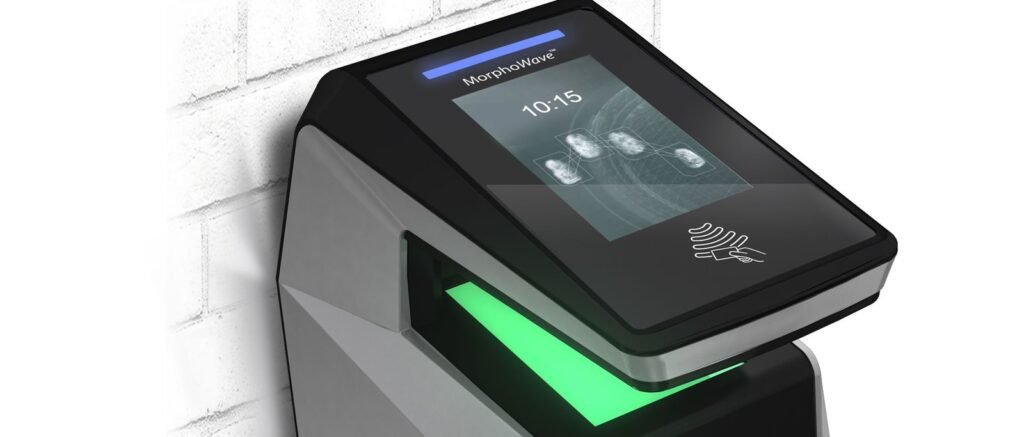
morphowave, access control, aranasecurity, idemia

What are biometrics

Biometrics is the use of people’s unique biological characteristics to identify and authenticate individuals. It’s considered to be the most reliable and efficient way for ID authentication. Unique identifiers include fingerprints, hand geometry, face geometry, retina and iris patterns and voice waves.   Current trends in Biometrics: With increasing threats from identity fraud and theft and new threats such as terrorism, new and advanced technology solutions are required and being implemented.   Biometrics has established itself as one of the most pertinent means of identification and authentication. It is being rolled out across many different sectors including governmental, travel, education, corporate and financial.   Although there is some reluctance and public acceptance, the increase in accuracy and security has meant it is becoming more publicly accepted. This has meant that it is being rolled out across industries and applications faster than ever before.   Typical use cases where biometric technologies are used: Law enforcement and public security (criminal/suspect identification) Military (enemy/ally identification) Border, travel, and migration control (traveller/migrant/passenger identification) Civil identification (citizen/resident/voter identification) Healthcare and subsidies (patient/beneficiary/healthcare professional identification) Physical and logical access (owner/user/employee/contractor/partner identification) Commercial applications (consumer/customer identification) Commercial buildings Types of Biometric Identification The oldest form of biometric verification is fingerprinting. Historians have found examples of thumbprints being used in ancient China as a means of unique identification on clay. Many law enforcement organisations have been using ink fingerprint identification for many decades. However, more recently Biometric verification has advanced considerably with computerized databases and the digitalising of analogue data.   Iris and retina biometrics was the next biometric methods to become more widely utilised. Iris identification became popular in the financial sector. More recently Facial and hand geometry has been the emerging technology and more widely used. An example of such technology is the iDemia MorphoWave Compact which uses hand geometry for identification. Facial-recognition technology has been used by law enforcement alongside CCTV for some time now to pick out individuals, however, more recently it is being used across different industries including mobile phones.   AI and Voice recognition is the most recent advancement in biometric identification. This method is being rolled out more in the commercial sector for consumers across many different applications and is becoming increasingly popular.   How are Biometrics used? No matter what biometric methodology is used, the identification and authentication process remains the same. A record of a person\’s unique characteristic is captured and kept in a database or locally on a device. When identification and verification are needed, a new record is captured and compared with the previous record in the database/device. If the data in the new record matches that in the database record, the person\’s identity is confirmed.

What are biometrics Read More »